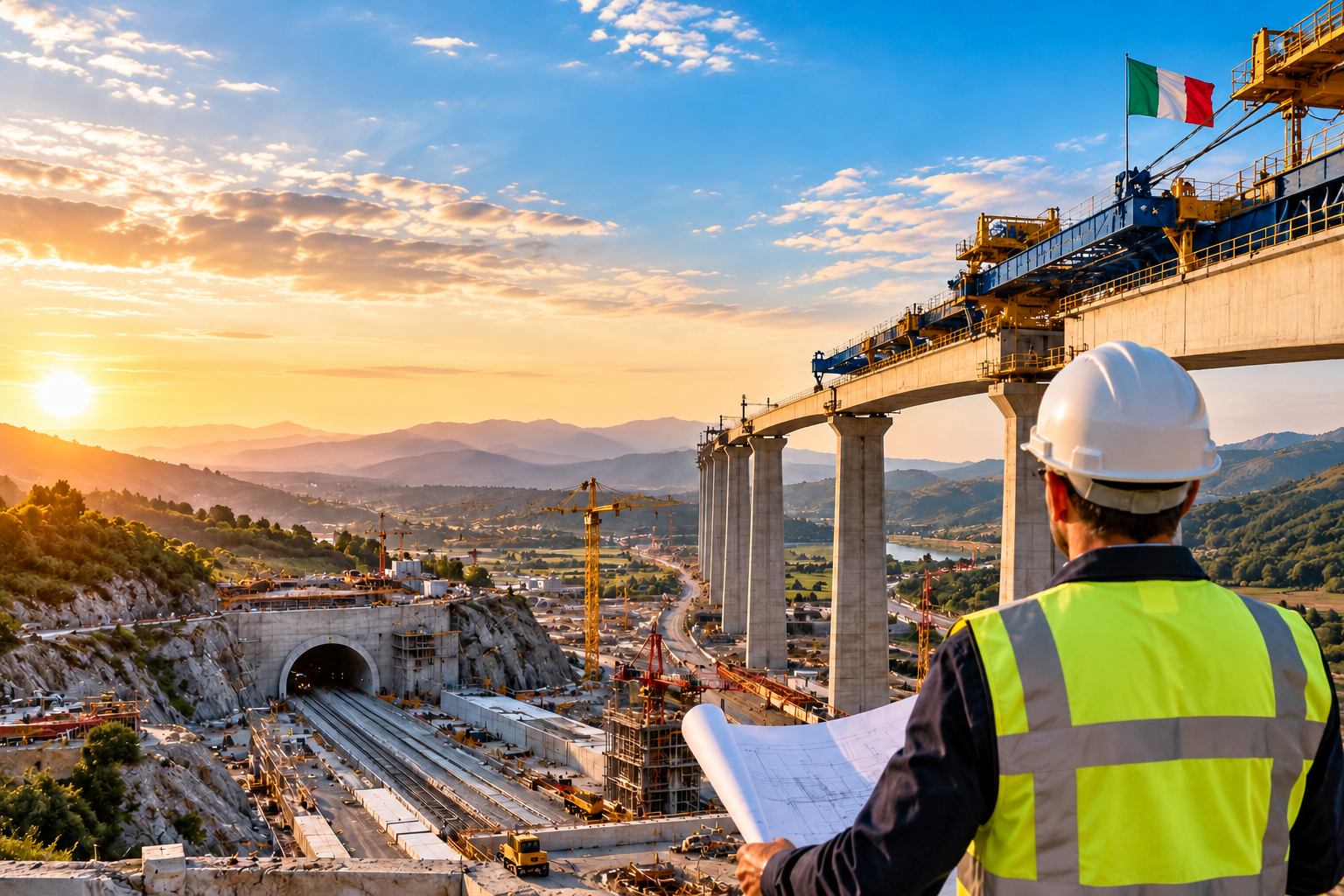
# Major Infrastructure Projects in Italy: The Role of Italian Companies and Technical Expertise
Major infrastructure projects are among the main drivers of economic and industrial development in Italy. Railways, motorways, bridges, tunnels, energy facilities and transport systems require substantial investment, advanced technologies and organisations capable of coordinating numerous specialist activities.
In this environment, **Italian engineering and construction companies play a leading role**, drawing on established expertise in the design, delivery and management of complex infrastructure.
## Major infrastructure projects reshaping the country
Italy is undertaking significant infrastructure modernisation programmes. Key initiatives include expanding high-speed rail, upgrading transport networks, maintaining and adapting existing infrastructure, and building new energy generation and distribution facilities.
Projects such as the Naples–Bari railway, upgrades along the Palermo–Catania–Messina corridor and works associated with the Turin–Lyon rail link illustrate the technical and organisational challenges facing the sector.
Delivering these assets involves not only major general contractors but also a broad network of engineering consultancies, specialist contractors, technology suppliers and qualified professionals.
## Italian excellence in complex projects
Italy’s major construction sector includes industrial businesses with an established international presence. Companies such as Webuild, Ghella and other specialist contractors help deliver infrastructure through engineering expertise, execution capabilities and technological solutions.
Italian contractors also bring valuable experience in particularly demanding operating environments, including underground works, mountainous sites, major civil structures and projects requiring the simultaneous coordination of multiple disciplines.
In these settings, **delivery quality depends as much on the people managing day-to-day operations as on the technologies deployed**.
## Essential professional roles on major construction sites
Every major project needs a multidisciplinary technical organisation whose specialists work in close coordination.
Project Managers, Construction Managers, Site Managers, civil and plant engineers, HSE Managers, quality specialists, planners and site supervisors all contribute to meeting project objectives.
Access to these professionals is especially important during peak delivery periods, when companies must quickly reinforce their teams without compromising schedules, quality or safety.
**Finding the right expertise at the right time is therefore a decisive factor in successful project delivery.**
## Safety, quality and coordination: operational priorities
On major infrastructure projects, meeting delivery schedules must go hand in hand with rigorous safety and quality management.
Qualified technical professionals help monitor work progress, coordinate contractors and subcontractors, verify compliance and respond promptly to operational issues.
Effective management of specialist resources also helps reduce delays, inefficiencies and conflicts between project phases.
## IMS Management: technical expertise supporting businesses
As projects become increasingly complex, businesses need access to specialist professionals who can integrate quickly into operational teams.
**IMS Management supports companies in recruiting and selecting technical and managerial professionals**, addressing both direct hiring and professional consultancy needs across Engineering, Construction Management, Project Management, HSE and Quality.
Our aim is to support project continuity and efficiency by matching business requirements with expertise suited to each operating environment.
## Investing in major infrastructure means investing in people
Major infrastructure assets are more than engineering works: they are investments in the economic, industrial and social future of communities.
Italian companies’ ability to meet these challenges will increasingly depend on combining technological innovation, well-organised processes and the development of professional expertise.
Behind every major infrastructure project lies an ambitious plan — and, above all, **people capable of turning it into reality**.